 VerbEdit
How Much Paraphrasing Is Enough
To Avoid Plagiarism?
It is the moment of panic every student or writer feels: You’ve rewritten a paragraph, but it still looks suspiciously like the original. You ask yourself, "Have I changed enough words? Is it still plagiarism if the sentence structure is the same?"
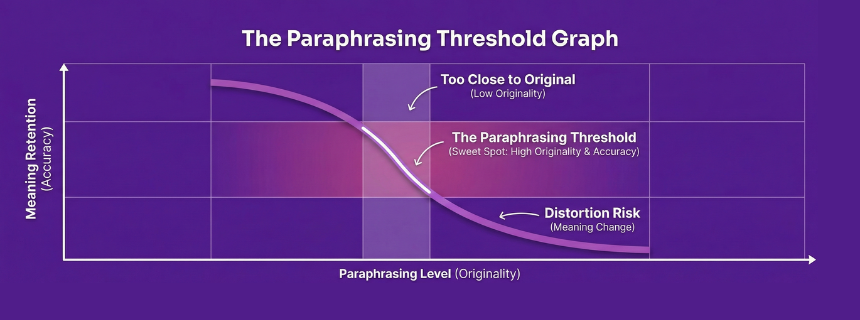
There is a common misconception that paraphrasing is a math problem—that if you change 20% or 30% of the words, you are safe. This is false.
As we defined in our guide to paraphrasing, the goal is to restate the idea, not just edit the text. In this post, we will look at exactly how much change is required to satisfy both ethical standards and plagiarism detection algorithms.
The "3-Word Rule" Myth
Many people are taught that if they don't use more than three words in a row from the original text, it's not plagiarism. While this is a helpful guideline, it is not a rule.
Plagiarism checkers (and human professors) look for the "fingerprint" of the sentence. If your version mirrors the logic, order, and rhythm of the original exactly, simply swapping synonyms is not enough. This is called patchwriting.
The Formula for "Enough"
To ensure your paraphrasing is sufficient, you must alter three specific layers of the text:
-
1Vocabulary: Synonyms are the first step, but not the only step.
-
2Syntax (Grammar): Change active voice to passive, or combine two sentences into one.
-
3Structure (Order): Present the information in a different sequence.
The "Squint Test": Visualizing the Difference
A great way to check if you have paraphrased enough is the "Squint Test." If you put the original paragraph and your new paragraph side-by-side and squint your eyes so the words blur, do the paragraphs look the same?
Are the sentences the same length? Do the commas appear in the same places? If they look visually identical, you haven't changed the structure enough.
Example: From "Not Enough" to "Perfect"
"Since the heavy rainfall went on during the weekend, the final game was delayed until next Tuesday."
Why it fails: The structure is identical. It is just a word-swap.
"The championship game had to be rescheduled for Tuesday due to persistent wet weather over the weekend."
Why it passes: The order is reversed (Effect first, then Cause), and the grammar is different.
Conclusion
"Enough" paraphrasing isn't about hitting a percentage; it's about breaking the link between the original author's sentence structure and your own. By combining the "4 R's" (Reword, Rearrange, Realize, Recheck), you can ensure your work is original every time.
Paraphrase with Confidence
Stop guessing if you've changed enough words. VerbEdit rewrites your text structurally to ensure complete originality.
Check Your Text Now