 VerbEdit
How to Paraphrase a Paragraph
Step by Step
Paraphrasing a single sentence is relatively easy. But when you are faced with a dense paragraph full of connected ideas, data points, and technical terms, the task becomes much harder. How do you rewrite the whole thing without losing the "flow" or getting tangled in grammar?
Many writers get stuck because they try to translate the paragraph sentence-by-sentence. This results in disjointed, awkward writing. Instead, you need a workflow that treats the paragraph as a single unit of meaning.
In this guide, we will apply the "4 R's" of paraphrasing (Reword, Rearrange, Realize, Recheck) to a full paragraph workflow.
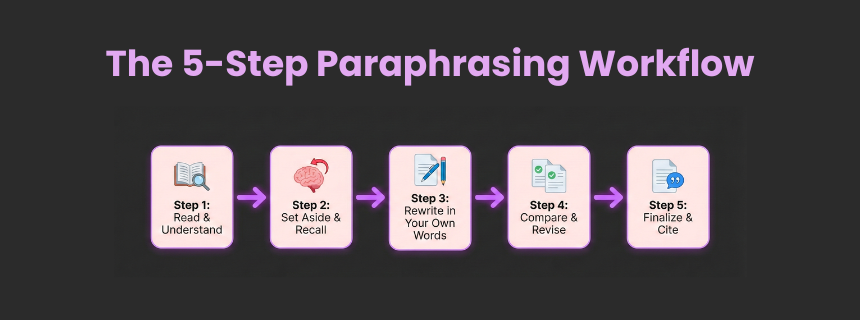
The 5-Step Paraphrasing Workflow
Read and "Decode"
Read the original paragraph at least three times. Identify the main idea (what is this mostly about?) and the supporting details. Underline key terms that cannot be changed (like proper nouns or specific dates).
The "Look Away" Moment
This is the most critical step. Hide the original text so you cannot see it. Do not look at it again until Step 4. This forces your brain to reconstruct the idea rather than just rearranging the words on the screen.
Draft Your Version
Write the paragraph from memory. Focus on the flow of ideas. Don't worry about perfect grammar yet—just get the concept down in your own voice. Try to start your sentences differently than the original author did (Rearrange).
Compare and Refine
Bring the original text back. Compare it with your draft.
- • Did you miss any key facts?
- • Did you accidentally use the exact same phrases (patchwriting)?
- • Reword any parts that are too similar using synonyms.
Cite Your Source
Never forget the final touch. Even if the words are yours, the idea belongs to someone else. Add your in-text citation or footnote immediately.
A Real-Time Example
"Bees are essential to the health of the planet's ecosystem. By pollinating flowers and crops, they ensure the survival of many plant species that other animals rely on for food. Without bees, the global food supply would be severely threatened, potentially leading to famine in certain regions."
The stability of our ecosystem depends heavily on bees. These insects are responsible for pollinating a vast array of crops and plants which serve as the foundation of the food chain for other species. If bee populations were to disappear, it could destabilize global agriculture and significantly increase the risk of hunger worldwide (Author, Year).
Conclusion
Paraphrasing a paragraph is about confidence. By stepping away from the original text and forcing yourself to explain it from memory, you naturally create something unique. It takes practice, but following these steps will make the process faster and safer.
Paraphrase Whole Paragraphs Instantly
VerbEdit is designed to handle long-form content, maintaining flow and context across multiple sentences.
Start Paraphrasing